
Commercial Gutters — Anne Arundel, Caroline & Queen Anne's Counties

Stop Water From Costing You More

No Subcontractors, Ever

Every installation is handled by our own trained crew — the same people who show up are accountable for the finished work.

GAF Master Elite Certified

Fewer than 2% of contractors nationwide hold this certification — it means better training, stricter standards, and warranties others can't offer.

MHIC Licensed and Insured

We carry Maryland Home Improvement Commission License #140145 — fully insured, fully above board, and easy to verify before you commit.

30-Plus Years Serving These Counties

Three decades serving Anne Arundel, Caroline, Queen Anne's, Talbot, Wicomico, and Kent counties in Maryland, plus Kent and Sussex counties in Delaware means we know the weather, the codes, and what commercial buildings here actually need.

A construction worker wearing gloves, a cap, and a tool belt measures metal with a tape measure on a stack of drywall inside a wooden-framed building under construction.

Commercial Gutter Installation Across Maryland & Delaware

Built for Commercial Buildings, Not Scaled-Up Homes

A commercial building drains a lot more water than a house. The roof area is larger, the rainfall here is heavier, and the consequences of a failed system go beyond aesthetics — overflowing gutters create slip-and-fall hazards, foundation problems, and interior water damage that tenants and insurance adjusters both notice. We install commercial gutter systems across Anne Arundel County, Talbot County, Wicomico County, Queen Anne’s County, Caroline County, and Kent County in Maryland, as well as Kent and Sussex counties in Delaware. Whether you’re managing a retail strip along Route 50 in Anne Arundel County, a medical office in Easton, a poultry facility in Caroline County, a manufacturing operation in Wicomico County, or a hospitality property in Rehoboth Beach, the system has to be sized and installed for the actual load — not guessed at. Every gutter we install is custom-fabricated on-site to the building’s exact measurements. No pre-cut sections, no weak joints in the middle of a run, no shortcuts.

Heavy-Duty Commercial Gutter Systems

What a Properly Installed System Actually Does

When the gutters work right, you stop thinking about them — and that’s exactly the point.

Water gets directed away from your foundation before it has a chance to cause settling or cracking.

Walkways, entryways, and loading areas stay dry — reducing slip-and-fall liability during heavy storms.

Interior walls and ceilings stay dry because water isn't backing up behind your fascia or siding.

Your system lasts — seamless aluminum gutters installed to commercial specs typically hold up for 25 years or more.

You avoid the compounding cost of deferred maintenance: rotted fascia, damaged soffit, and mold remediation are all far more expensive than the gutters themselves.

If storm damage hits, we document everything and work directly with your insurance company — using the same estimating software adjusters use.

Ready to get started?

A bold white number 1 centered inside a solid black circle on a plain white background.

Share project details

Call us or get a free online quote to help us identify your project needs.

A bold white number 2 centered inside a solid black circle on a plain background.

We'll follow up

If you requested an online quote, you can expect a callback within 24-48 hours of your request.

A bold white number 3 is centered inside a solid black circle on a plain background.

The floor is yours

Connect with an expert and share all project specifics.

A bold white number 4 centered inside a solid black circle on a plain background.

Plan your project

Like what you hear? We'll provide next steps and expert guidance.
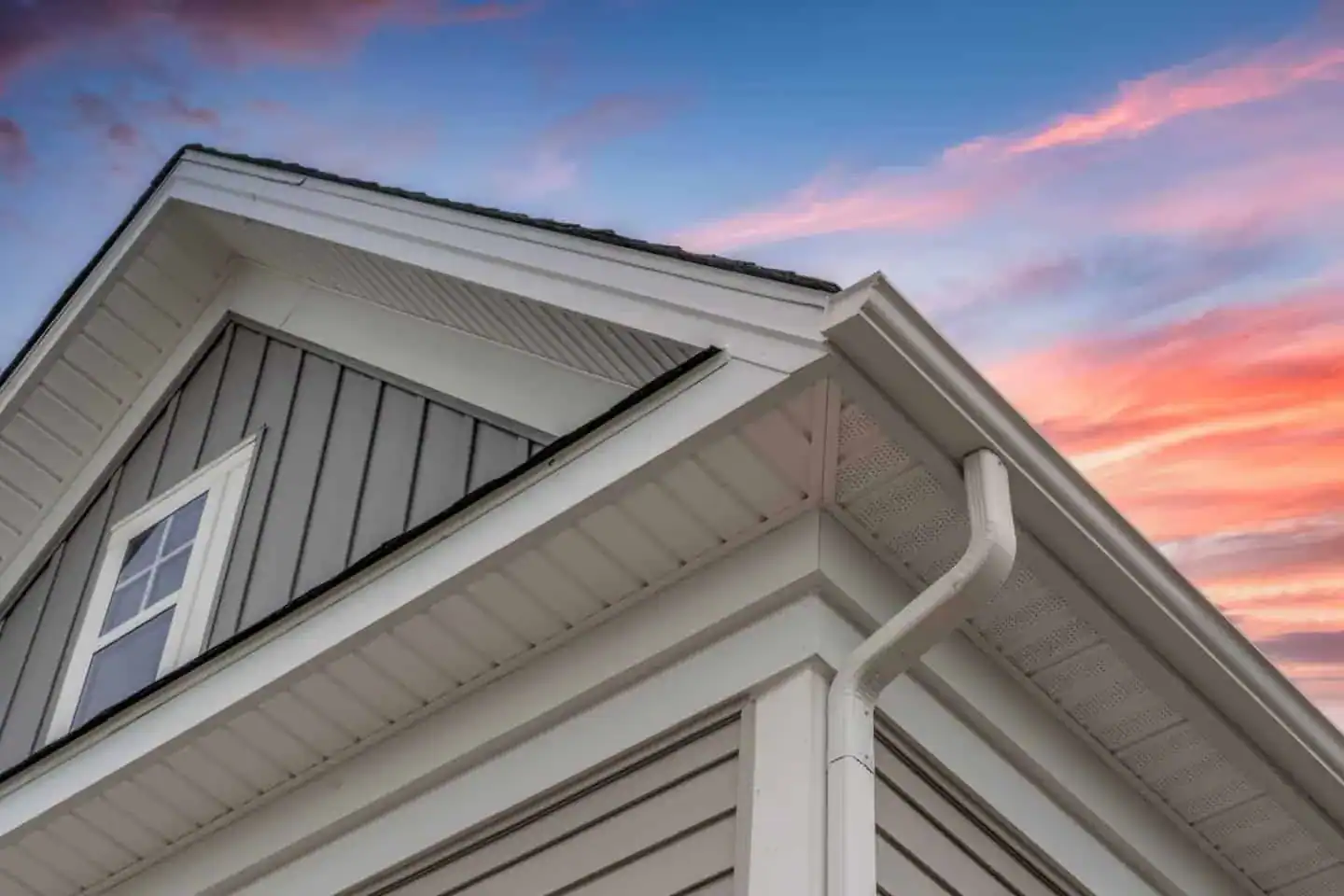
Close-up view of a house’s corner showing white gutters and gray siding, with a window and angled roofline, set against a colorful sunset sky with pink, orange, and blue hues.

Commercial vs. Residential Gutter Systems

Commercial Gutters Are a Different Animal

One of the most common mistakes we see is a contractor installing residential-spec gutters on a commercial building. The gutters might look fine at first. But residential hanger spacing runs 24 to 36 inches on center — commercial work requires 18 to 24 inches, sometimes tighter at corners and downspout outlets where load concentrates. The difference shows up the first time a heavy July thunderstorm rolls through. The region spanning Anne Arundel County through Wicomico County in Maryland, plus Kent and Sussex counties in Delaware, averages 43 to 48 inches of rain per year. In peak summer, thunderstorms hit roughly every five days. Coastal properties in Sussex County deal with nor’easters and Atlantic salt spray on top of that. The system has to be built for those conditions — not for a neighborhood in a drier climate. We install K-style, box, and seamless commercial gutters depending on the building type and drainage requirements. For larger commercial structures, box gutters are often the right call — they hold more volume and handle high-load drainage situations that K-style systems aren’t designed for. We’ll tell you which is appropriate for your building and why, not just what’s easiest to install.

Custom Commercial Gutters & Seamless Installation

What You Actually Get When We Show Up

Before any material goes up, we walk the building. We look at the roofline, the existing fascia, the drainage path, and anything that needs attention before new gutters can be properly anchored. If there’s rotted fascia board behind where the gutter mounts, we handle that first — because hanging a new system on compromised wood is a short-term fix that creates a longer-term problem. The gutters are fabricated on-site to the building’s exact dimensions. That means one continuous run from corner to downspout, with no mid-run seams where leaks typically start. Downspouts are positioned to route water away from storefronts, parking areas, and foundations — not just off the roof. We also install gutter guards on commercial properties where leaf accumulation or debris is a recurring issue, which is common across Talbot County, Caroline County, and Queen Anne’s County given the tree coverage. The goal is a system that performs through the full cycle of seasons — spring rains, summer storms, fall leaf drop, and winter freeze-thaw — without requiring constant attention.
Autumn Leaves Gutter Guard installed on a residential home in Talbot County, Maryland by Bay Area Exteriors, protecting gutters from leaves and debris while enhancing roof performance
Commercial Gutters FAQs

Common questions about Commercial Gutters

The core difference comes down to load, sizing, and engineering. Commercial buildings have larger roof areas that shed more water, which means the gutters need to be bigger, the hangers need to be spaced tighter, and the downspouts need to be positioned more deliberately. Residential systems typically use 5-inch gutters with hangers every 24 to 36 inches. Commercial work calls for 6-inch or larger gutters — sometimes box gutters for high-volume drainage — with hangers spaced 18 to 24 inches on center. Apply residential specs to a commercial building and the system will sag, leak, and overflow under the kind of storms we see regularly across Anne Arundel, Caroline, Queen Anne’s, Talbot, Wicomico, and Kent counties in Maryland, plus Delaware’s coastal areas.
A few things tell the story pretty quickly. If you’re seeing water overflow during moderate rain — not just in a major storm — the system is either clogged, undersized, or improperly pitched. Sagging sections mean the hangers have failed or the fascia behind them has deteriorated. Visible rust, peeling seams, or sections pulling away from the roofline are signs the material itself is giving out. In many cases, repair is the right call. But if the system is more than 20 years old, was installed to residential specs on a commercial building, or has multiple failure points, replacement is usually the more cost-effective path over a five-year horizon.
Yes, and this is an area where a lot of property owners get caught off guard. In Maryland, commercial properties in the Chesapeake Bay watershed — which covers all the Eastern Shore counties we serve, including Anne Arundel, Talbot, Queen Anne’s, Caroline, Wicomico, and Kent counties — are subject to stormwater management regulations that affect how water is directed off your building and where it goes once it leaves the downspout. Delaware coastal properties in Kent and Sussex counties have their own stormwater and environmental regulations tied to proximity to waterways and wetlands. Beyond that, commercial gutter systems need to comply with local building codes governing drainage capacity and material standards. We’re familiar with the requirements across all the counties we serve and install systems that meet them.
We install K-style seamless gutters, box gutters, and half-round systems depending on the building type and application. K-style is the most common for general commercial use — it handles solid drainage volume and works well on most rooflines. Box gutters are the right call for larger structures with high-volume drainage requirements, like the agricultural and processing facilities common across Caroline and Wicomico counties, or larger retail and office buildings. Half-round gutters are sometimes required or preferred on historic commercial properties — particularly in places like downtown Annapolis or Chestertown, where architectural character matters. We’ll recommend the right system for your building based on the actual drainage load, not just what’s easiest to install.
Yes, and it’s something we do regularly. We use the same estimating software that insurance companies use, which means our documentation is in the format adjusters expect and typically moves through the review process faster. When a nor’easter comes through or a summer storm causes damage across Sussex County, Anne Arundel County, or any of the counties we serve, we can assess the damage, document it thoroughly, and communicate directly with your insurance company on your behalf. A lot of commercial property owners leave money on the table simply because the damage wasn’t documented correctly or the claim wasn’t presented in a way the adjuster could act on. We take that off your plate.
A properly installed seamless aluminum commercial gutter system typically lasts 25 years or more. Sectional systems — the kind with joints every few feet — tend to fail sooner because the seams are the weakest point, and they collect debris and allow water to sit. Material gauge matters too: commercial-grade aluminum runs 0.040 to 0.050 inches thick, which holds up significantly better than the thinner stock used in residential applications. On coastal properties in Sussex County or along the Chesapeake Bay in Anne Arundel and Talbot counties, salt air accelerates corrosion, so material selection and protective coatings matter more. Regular maintenance — keeping gutters clear of debris, particularly in the heavy leaf seasons across Talbot and Queen Anne’s counties — extends the life of any system considerably.
A bold white number 1 centered inside a solid black circle on a plain white background.

On-Site Assessment

We walk the building, measure the roofline, assess drainage needs, and identify any fascia or structural issues before quoting.

A bold white number 2 centered inside a solid black circle on a plain background.

Detailed Written Estimate

You get a line-item estimate with materials, labor, and timeline spelled out — no vague numbers, no change-order surprises later.

A bold white number 3 is centered inside a solid black circle on a plain background.

Custom Fabrication and Install

Gutters are formed on-site to exact measurements, installed by our own crew, and tested before we leave the property.