Summary:
Your flat roof shouldn’t keep you up at night. Yet if you’re dealing with recurring leaks, watching energy bills climb every summer, or wondering whether that aging membrane will survive another Maryland storm season, you’re facing decisions that affect both your budget and your peace of mind. TPO roofing has become one of the most popular solutions for flat and low-slope roofs across Talbot County, MD, and for good reason. This guide walks you through everything you need to know—from how TPO systems work and what they cost, to how they perform in our coastal climate and when replacement makes more sense than another patch job.
What Is TPO Roofing and How Does It Work
TPO stands for thermoplastic polyolefin, which is a single-ply roofing membrane designed specifically for flat and low-slope applications. Think of it as a large, durable sheet made from a blend of polypropylene and ethylene-propylene rubber that gets rolled across your roof deck and heat-welded at the seams to create one continuous, watertight surface.
The material typically comes in white, which isn’t just about appearance. That reflective surface redirects up to 85 percent of solar radiation away from your building, keeping interior spaces cooler and reducing the load on your HVAC system during Maryland’s humid summers. For commercial properties in Talbot County, MD, this translates to measurable cooling cost reductions month after month.
TPO systems consist of three functional layers working together. The bottom layer provides the elastomeric foundation that allows the roof to expand and contract with temperature changes. The middle layer contains reinforced polyester for strength and puncture resistance. The top layer delivers UV protection and that energy-saving reflective surface that makes TPO roofing one of the fastest-growing choices in commercial roofing specialties.
How Commercial Roofing Contractors Install TPO Systems
Installation method matters as much as the material itself when you’re working with commercial roofers. A TPO roof is only as good as the crew installing it, which is why understanding the process helps you evaluate contractors and know what to expect.
The process starts with thorough deck preparation. Your existing roof surface needs to be clean, dry, and free from damage. Any deteriorated decking gets replaced, and drainage issues get addressed before new materials go down. Skipping this step leads to problems down the road, no matter how good your membrane is.
Next comes the insulation layer, typically polyiso or EPS boards that provide thermal resistance and create a smooth, level surface for the TPO membrane. Many commercial flat roofing contractors add a cover board over the insulation for extra protection against punctures and to improve fire resistance.
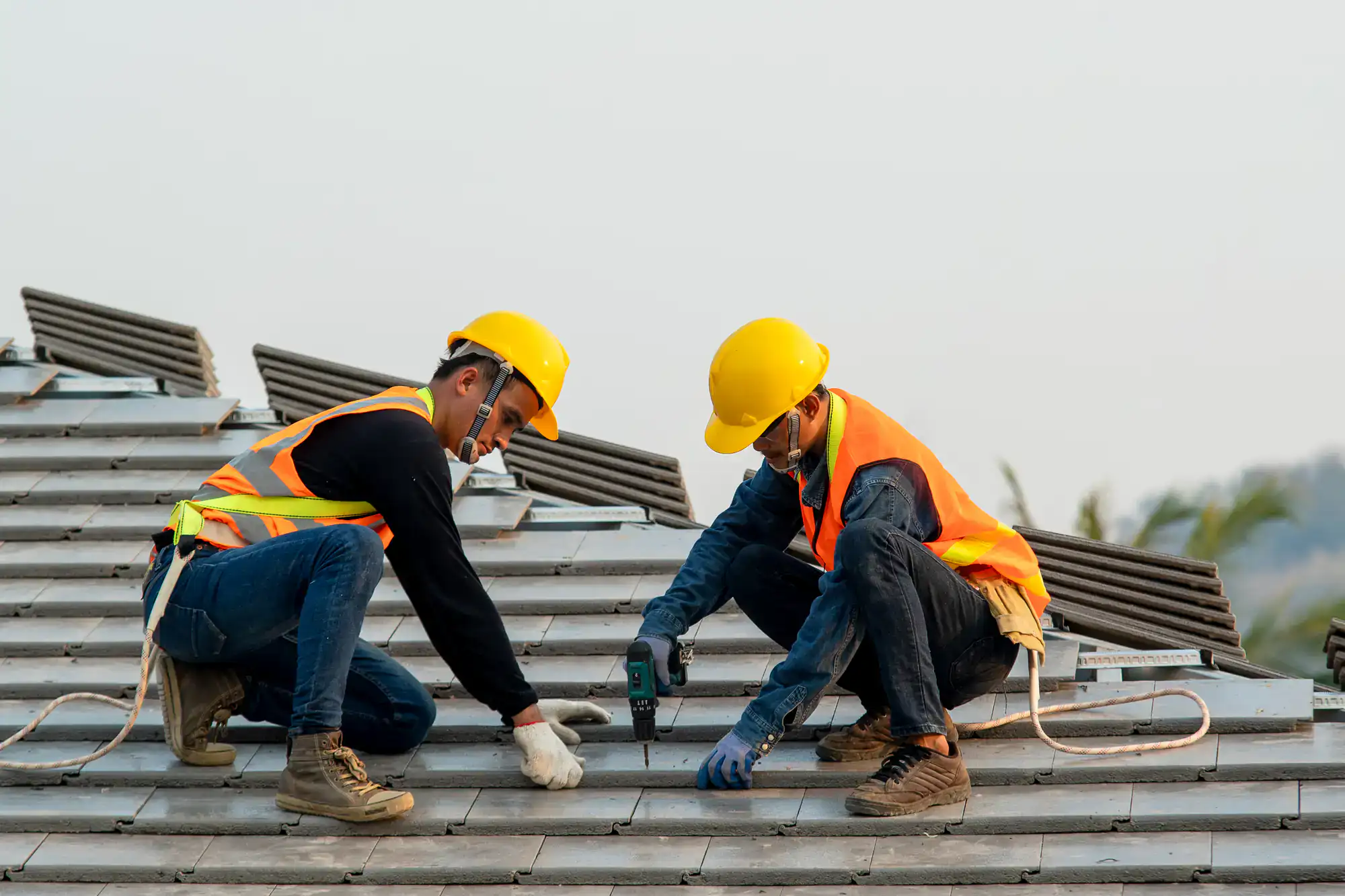
Then the TPO sheets get rolled out across the roof with overlaps of about 6 inches at the seams. This is where installation expertise becomes critical. Those seams get fused together using hot-air welders that heat the material to around 900 degrees Fahrenheit. The heat melts the overlapping layers, and as they cool, they form a permanent bond that’s actually stronger than the membrane itself.
Every seam gets tested. Professional flat roof contractors probe each weld with a pointed tool to check for any spots that didn’t fuse properly. Those get immediately re-welded. This attention to detail is what separates installations that last 20-plus years from those that start leaking within a few seasons.
Flashing comes next—the detailed work around every roof penetration, edge, and transition point. Vents, HVAC units, skylights, drains—each one needs custom flashing that gets heat-welded into the main membrane to maintain that continuous waterproof barrier. This is precision work that requires experience with TPO-specific techniques and represents a key part of complete roofing system protection.
The attachment method varies based on your roof type and building requirements. Mechanically fastened systems use screws and plates along the seams, with the next sheet overlapping to hide the fasteners. Fully adhered systems bond the membrane to the substrate with adhesive across the entire surface. Ballasted systems use river rock or pavers to hold the membrane in place. Each method has specific applications where it performs best.
Why Commercial Flat Roofing Contractors Recommend TPO
TPO has grown from a niche product to the fastest-growing segment in roofing commercial applications, and that popularity stems from real performance advantages that matter to property owners in Talbot County, MD.
Energy efficiency tops the list for most commercial properties. When your white TPO membrane reflects solar heat instead of absorbing it, your building stays cooler without working your air conditioning system overtime. In our humid climate, where summer temperatures regularly push into the upper 80s and 90s, that translates to cooling cost reductions of 20 to 30 percent. Over a 20-year lifespan, those energy savings can offset a significant portion of your initial installation investment.
The heat-welded seams deliver reliability that adhesive-based systems can’t match. When those overlapping sheets get fused together at 900 degrees, you’re creating seams that are nearly four times stronger than the taped seams used in EPDM rubber roofing installations. That strength matters when high winds try to peel your roof apart or when thermal cycling puts stress on every connection point.
TPO handles building movement and temperature fluctuations without developing the stress cracks that plague more rigid materials. Maryland’s Eastern Shore sees temperature swings from freezing winters to hot, humid summers. Your roof expands in heat and contracts in cold, sometimes experiencing 40-degree temperature drops in a single afternoon. TPO’s flexibility accommodates that movement without compromising the waterproof barrier.
Chemical resistance makes TPO ideal for commercial kitchens, industrial facilities, or any building where rooftop exhaust systems discharge oils, grease, or other substances. The material resists degradation from these exposures better than many alternatives, maintaining its integrity even in challenging environments.
Installation efficiency means less disruption to your operations. Those large membrane rolls—typically 10 to 12 feet wide—cover substantial square footage quickly. Fewer seams mean faster installation and less time with crews on your roof. For active commercial facilities where business continuity matters, that efficiency has real value beyond just labor cost savings.
The environmental profile appeals to property owners with sustainability goals. TPO contains no chlorine, unlike PVC. It’s fully recyclable at end of life. It contributes to LEED certification points. And those energy savings reduce your carbon footprint month after month, year after year.
Flat Roof Installation Costs and Pricing in 2026
Understanding what you’ll actually pay helps you budget realistically and compare quotes from flat roofing companies intelligently. TPO installation typically costs between 5 and 10 dollars per square foot, including both materials and labor. For a standard 1,500-square-foot flat roof, that translates to a total investment of roughly $7,500 to $15,000.
Several factors influence where your project falls within that range. Membrane thickness matters—45-mil, 60-mil, and 80-mil options each carry different price points, with 60-mil offering the sweet spot of performance and flat roof cost for most commercial applications. Your attachment method affects pricing too, with fully adhered systems typically costing more than mechanically fastened installations due to adhesive materials and additional labor.
Labor accounts for 40 to 60 percent of your total project cost, which is why contractor selection matters so much. You’re not just paying for materials; you’re investing in expertise, proper installation techniques, and the quality control that determines whether your roof lasts 15 years or 30.
Flat Roof Replacement Cost Compared to Other Materials
TPO sits in the middle of the flat roof replacement cost spectrum, offering excellent value when you factor in performance and longevity. Modified bitumen comes in slightly lower at $4 to $8 per square foot but doesn’t deliver the same energy efficiency or lifespan. EPDM rubber roofing costs similarly to TPO—$5 to $9 per square foot—but lacks the reflective properties that drive energy savings.
PVC roofing runs $6 to $12 per square foot, offering superior chemical resistance but at a premium price that’s 25 to 35 percent higher than TPO for comparable performance in most applications. Metal roofing costs significantly more—$7 to $14 per square foot—though it delivers the longest lifespan of any flat roof material.
When you’re evaluating bids from commercial flat roofing contractors in Talbot County, MD, make sure you’re comparing equivalent scopes. Some quotes include tear-off and disposal of your existing roof; others price that separately at $1 to $2 per square foot. Insulation upgrades, cover boards, enhanced flashing details, and warranty packages all affect your bottom line.
The cheapest quote rarely delivers the best value. What matters is the total cost of ownership over your roof’s lifespan. A TPO system installed by experienced flat roof specialists might cost $2,000 more upfront than a budget alternative, but if it lasts five years longer and saves $500 annually in energy costs, you’re ahead by $4,500 over the roof’s life.
Timing can affect pricing too. Scheduling your project during fall or early spring, when contractor demand is lower, sometimes yields better rates than peak summer season. But don’t sacrifice quality for a discount. The difference between proper installation and rushed work shows up in performance, not just price.
Financing options make quality installations more accessible. Many contractors offer terms that let you spread the cost over 24 to 36 months, sometimes with promotional zero-percent interest periods. When you’re weighing repair versus replacement, financing can make the smart long-term decision financially feasible today.
Flat Roof Repair Cost Versus Full Replacement
Knowing when to repair and when to replace saves money and prevents the frustration of throwing good money after bad. Flat roof repair cost typically runs between $300 and $1,100 for common issues like small leaks, damaged flashing, or isolated membrane problems. More extensive repairs can run $150 to $4,000 depending on the scope.
The decision point comes down to your roof’s age, the extent of damage, and repair frequency. If your roof still has more than half its expected lifespan remaining and damage is localized to a specific area, repair usually makes sense. A 10-year-old TPO roof with a puncture from fallen debris? Repair it. That same roof with multiple failing seams and widespread membrane deterioration? Replacement is probably your better investment.
The 30-percent rule provides useful guidance. When your flat roof repair cost approaches 30 percent of what full replacement would cost, replacement typically delivers better long-term value. If you’re spending $3,000 to patch a roof that would cost $10,000 to replace, you’re at that threshold where replacement deserves serious consideration.
Frequency matters too. If you’re calling flat roofers for repairs multiple times per year, those costs add up quickly. More importantly, repeated problems signal that your roof system is failing, not just experiencing isolated issues. At that point, you’re in reactive mode—constantly addressing symptoms rather than solving the underlying problem.
Age provides another decision factor. Most TPO roofs last 20 to 30 years with proper maintenance. Once your roof passes the 15-year mark, any significant repair should trigger a replacement evaluation. You don’t want to invest thousands in repairs on a roof that’s approaching end of life anyway.
Professional assessment removes the guesswork. We can evaluate your roof’s overall condition, identify underlying issues that might not be visible, and provide honest guidance on whether repair or replacement makes better financial sense for your specific situation in Talbot County, MD. That expertise is worth the inspection cost, especially when you’re facing a major decision.
EPDM Rubber Roofing Versus TPO: Material Comparison
EPDM and TPO are the two most common single-ply membranes for flat roofs, and property owners often weigh them against each other when working with rubber roofing specialists. Understanding the real differences helps you choose the right material for your building and climate.
EPDM—ethylene propylene diene monomer—is synthetic rubber that’s been around since the 1960s. It typically comes in black, though white EPDM is available at higher cost. TPO is newer, introduced in the 1990s, and almost always comes in white or light gray.
That color difference drives the biggest performance distinction. Black EPDM absorbs solar heat, which can benefit buildings in colder climates by providing passive heating. But in Maryland’s humid climate with hot summers, that heat absorption works against you, forcing your cooling system to work harder. White TPO reflects that heat, keeping your building cooler and reducing energy costs.
Seam strength favors TPO significantly. Those heat-welded TPO seams are nearly four times stronger than EPDM’s adhesive-taped seams. In practical terms, that means TPO seams are less likely to fail over time, especially under stress from thermal cycling, building movement, or severe weather.